Kunststoff-Modulriemen-Teilungsführung
Pitch is the centre-to-centre spacing of repeating hinge or module geometry. It is a powerful identifier, but it does not define the conveying face, underside or sprocket compatibility by itself.
What pitch measures
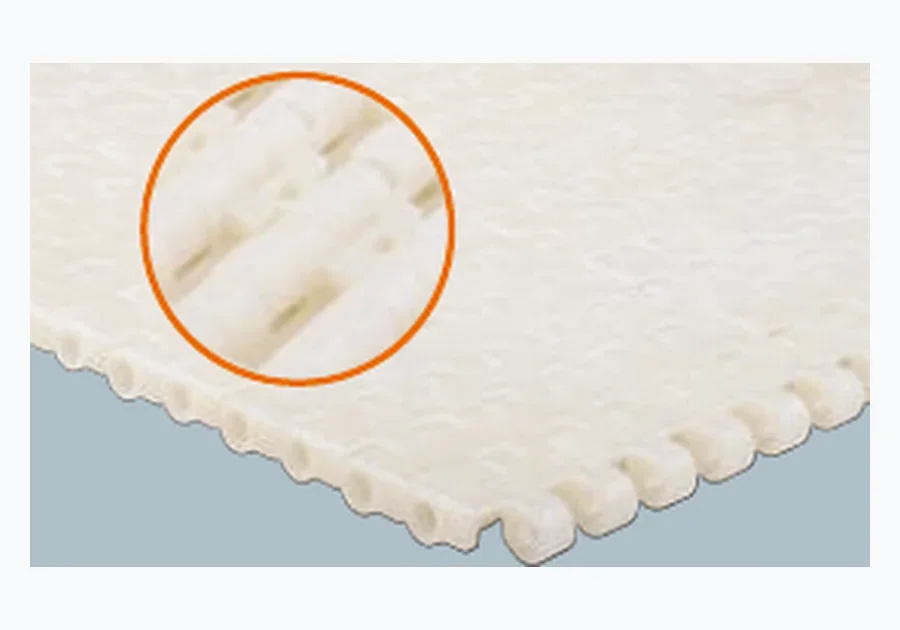
Pitch is the repeating distance in the modular hinge/module geometry. In replacement work, measure across several repeats and divide by the number of pitches rather than relying on one worn edge. This reduces error and helps distinguish neighbouring nominal families.
Pitch family reference
| Tonhöhe | Family direction | Practical selection note |
|---|---|---|
| 12,7 mm | Flat / closed examples | Fine pitch; useful starting point for compact transfers and small product support. |
| 15,2 mm | Flat + 14% / 28% open-grid examples | Fine-pitch family with both continuous support and process opening options. |
| 19,05 mm | Flat + 16% open-grid example | Mid-fine family for straight-running support or moderate drainage. |
| 25 mm | Flat + 29% open-grid + 52% radius example | Broad general-purpose pitch with straight and radius examples. |
| 25,4 mm | Flat + 8% / 34% / 35% straight + 47% / 55% radius examples | The widest mix of faces and running paths in this comparison. |
| 27,2 mm | 38% open-grid examples | Higher-open-area straight-running reference. |
| 50,8 mm | Flat/specialty + one 20% open example | Larger-pitch family for duties where fine transfer is not the main driver. |
| 63,5 mm | Flat / closed example | Largest pitch shown in this modular-belt comparison range. |
Pitch and transfer geometry
Smaller pitch often supports compact transfer geometry because the module and sprocket system can be correspondingly finer. That does not guarantee a specific minimum transfer diameter. The actual belt edge, hinge and sprocket geometry must still be confirmed.
Pitch and product footprint
Pitch is not the same as opening size. A fine-pitch open belt can still have openings that matter to a small product, while a larger-pitch flat belt can provide continuous top support. Look at the face pattern and product footprint together.
Pitch and sprockets
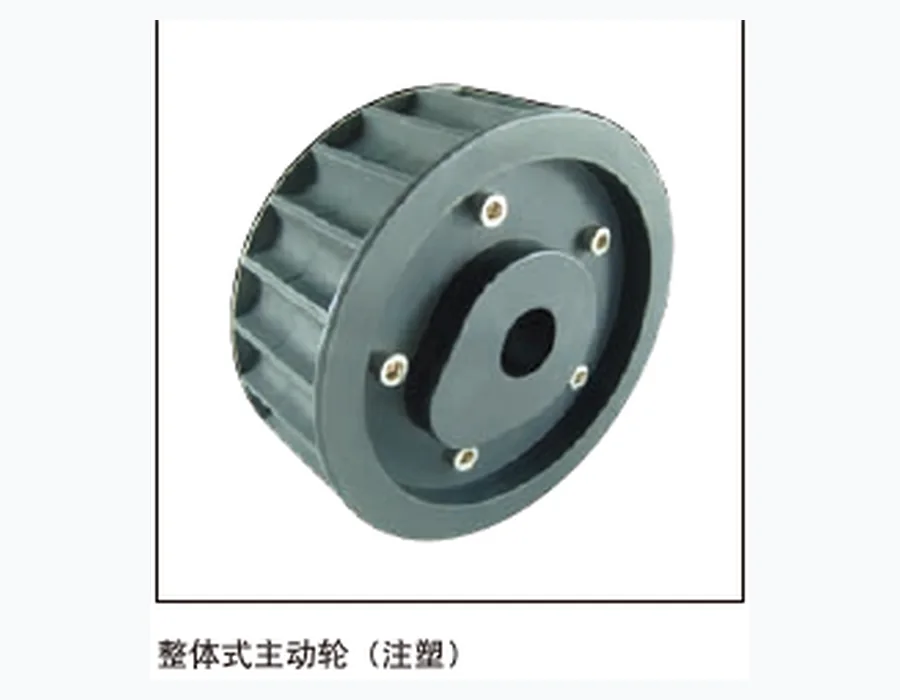
The drive pitch must correspond to the belt family, but compatibility goes further: underside tooth engagement, sprocket thickness/form, tooth count, bore/shaft and spacing all matter. This is why a pitch-only replacement can fail even when the nominal number is correct.
Replacement measurement method
| Measurement | Method |
|---|---|
| Tonhöhe | Measure several repeating centres and divide |
| Width | Measure overall belt width and edge/module detail |
| Top face | Photograph pattern/opening and any flights/attachments |
| Underside | Photograph drive/hinge geometry |
| Sprocket | Photograph engaged teeth and record shaft/bore |
| Weg | Record straight or radius conveyor geometry |
When to use the pitch as a search term
Pitch-specific product pages are useful because they narrow the mechanical family for buyers. They should not be treated as proof that all surfaces, widths or materials are available at that pitch. Use the pitch to enter the range, then confirm the final configuration.
Worked identification example
Suppose an existing belt appears to be about 25 mm pitch. Measure ten repeating hinge centres instead of one module, then divide the total by ten. Next record the overall width, face pattern and underside. If the conveyor includes a horizontal curve, the 25 mm measurement does not point to the same family as a straight 25 mm belt. The curve geometry becomes a separate deciding input.
The same method is useful at 25.4 mm, where this range contains flat, open-grid, specialty and radius directions. Pitch narrows the search; the other geometry completes it.
Need help narrowing the configuration?
Send the information you already have. Missing fields can be identified during review rather than guessed.