Conveyor Wear Strip Selection Guide
Wear strips support and locate a belt or chain through the conveyor frame. Profile shape and mounting interface normally matter more than a generic strip description.
Wear strips support and locate the moving product
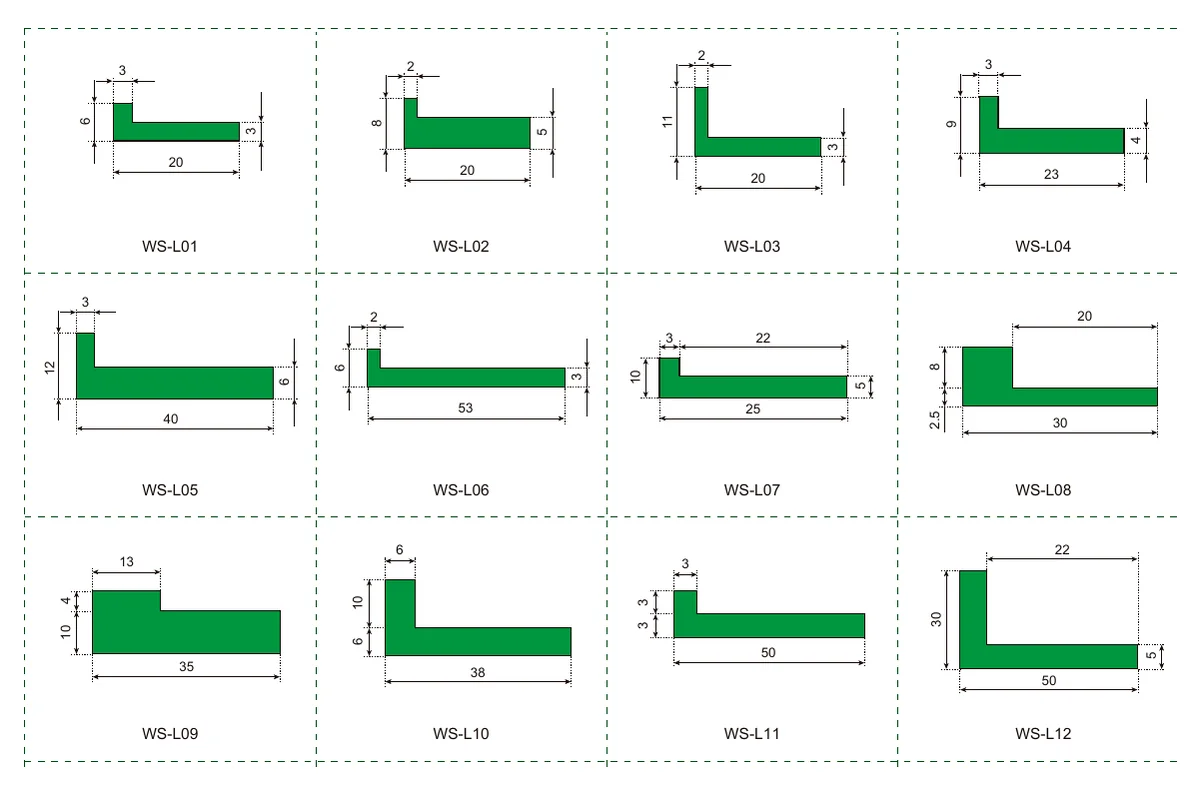
Wear strips sit between the moving belt/chain and the conveyor frame. Their job can be simple vertical support, lateral location, return support or part of a guide path. Profile geometry should therefore be identified before material or cut length is discussed.
Wear-strip profile families
The wear-strip range includes flat strips and many L, Z, LK, ZK, T, U, TU, TC, K, H and F profile directions. The exact section should be taken from the frame or drawing because similar-looking profiles can place the belt at a different height or lateral position.
Flat-section examples
| Width × height (mm) |
|---|
| 15×6 |
| 15×15 |
| 20×4 |
| 20×5 |
| 20×6 |
| 20×10 |
| 25×3 |
| 25×6 |
| 25×10 |
| 30×3 |
| 30×20 |
| 30×30 |
| 33×10 |
| 35×6 |
| 35×8 |
| 35×12 |
| 40×3 |
| 40×4 |
| 40×5 |
| 40×6 |
| 40×8 |
| 40×10 |
| 42×3 |
| 42×5 |
| 42×6 |
| 42×7 |
| 45×3 |
| 50×3 |
| 50×4 |
| 50×5 |
| 50×20 |
| 55×4 |
| 55×6 |
| 55×8 |
| 60×3 |
| 60×6 |
| 70×3 |
| 70×5 |
| 70×6 |
| 70×8 |
| 75×4 |
| 80×6 |
| 80×10 |
| 90×5 |
| 90×6 |
| 100×2 |
| 100×5 |
| 100×10 |
| 110×3 |
| 140×4 |
Measure the mounting interface
Record profile width, height and lip/leg dimensions, plus how the strip is retained in the conveyor. If the strip sits inside a metal carrier or track, photograph the carrier as well. Length should be set after the section and mounting are confirmed.
Wear patterns are diagnostic
Uneven wear can indicate belt tracking, alignment or guide-load issues. Photograph worn strips before replacing them. A new strip with the same section will not correct a conveyor that is forcing the belt laterally.
Wear-strip RFQ
| Measure | Why |
|---|---|
| Profile section | Defines frame fit and support location |
| Width × height / lip dimensions | Confirms geometry |
| Length and quantity | Sets cut requirement |
| Carrier/mounting | Prevents wrong retention method |
| Belt or chain | Confirms contact surface and duty |
| Wear pattern | Can reveal alignment or guide problems |
Use the worn strip as a diagnostic clue
A wear strip that is polished evenly along its full contact face tells a different story from one that is heavily worn on one edge. Localised wear can point to misalignment, a guide-load concentration or an incorrect profile position. Photograph the strip in the frame before removal and again after removal so the wear direction can be understood.
When measuring a badly worn section, use an unworn end or another strip as the dimensional reference. Copying the worn cross-section can build the old damage into the replacement specification.
Need help narrowing the configuration?
Send the information you already have. Missing fields can be identified during review rather than guessed.