Flat Surface vs Open Grid Modular Belts
Flat faces prioritise continuous product support; open-grid faces create paths for water, air or debris. The right choice follows the process and the smallest product footprint.
The core trade-off
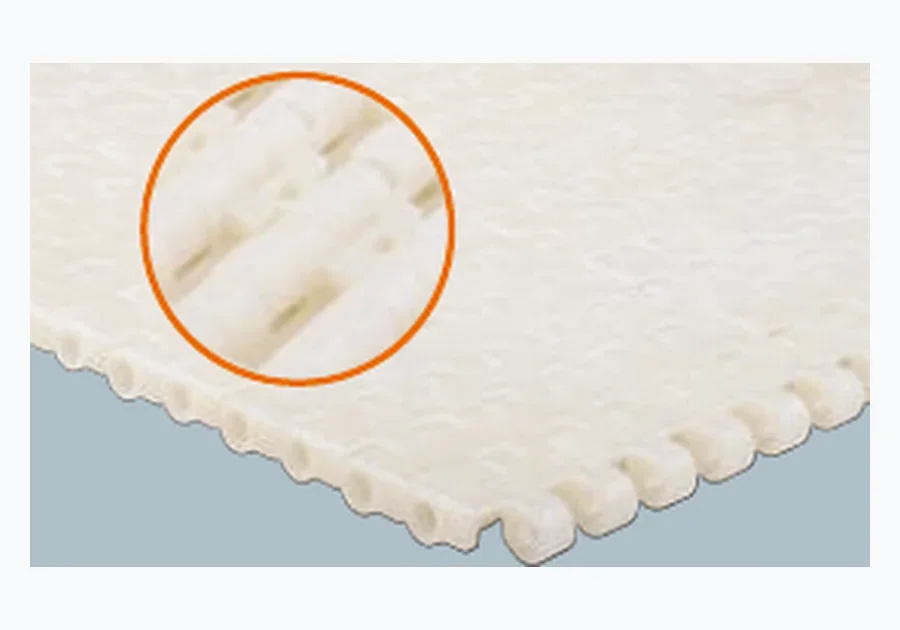
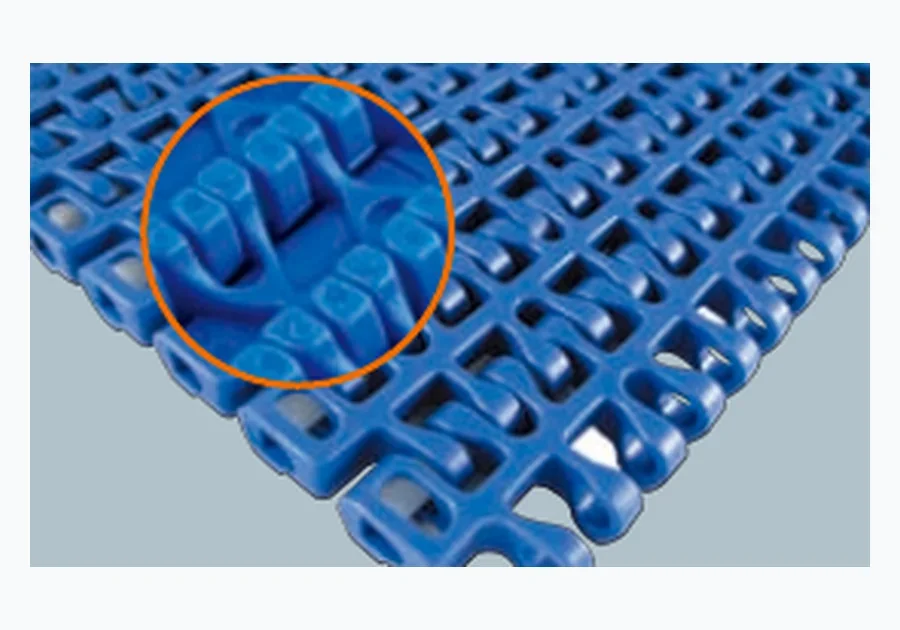
Flat surfaces maximise continuous contact area. Open-grid surfaces intentionally remove contact area to create paths for liquid, air or debris. The best choice therefore follows the process function and the smallest product footprint rather than a generic industry label.
Buyer comparison
| 決断 | 平らな/閉じた | オープングリッド |
|---|---|---|
| 製品サポート | Continuous contact; strong baseline for small bases | Must verify the product bridges the opening pattern |
| 排水 | 限定的なベルト排水 | Primary advantage when water must pass through |
| Cooling / airflow | ベルトを貫通する空気の流れが制限される | Can support through-belt airflow |
| Transfer | Often useful for fine transfers | Confirm edge and opening geometry |
| 破片放出 | Debris remains on belt until removed | Can allow crumbs/debris to pass through |
| Visual inspection | Stable product presentation | May be useful when visibility or drainage is more important |
Why one line may use both
A wash line can use open grid in the dewatering section and a flat face during inspection or packing. A bakery line can cool on an open surface and transfer wrapped product on a closed surface. Specifying by conveyor section avoids forcing one compromise belt through every process step.
Open area is not the whole picture
The comparison range includes several open-area percentages, but two belts with the same percentage can distribute the opening differently. The smallest product contact points should be compared with the real pattern, not only the number in a table.
Drive compatibility remains separate
Changing from flat to open grid at the same nominal pitch does not automatically preserve the underside/sprocket interface. Confirm the actual family and sprocket engagement before treating the face change as a drop-in replacement.
RFQ decision checklist
| If your main concern is… | Send… |
|---|---|
| Small product support | Product dimensions and transfer gap |
| 排水 | Water duty, product footprint and desired release |
| Cooling | Airflow objective and product support requirement |
| 交換 | Pitch, width, face, underside and sprocket photos |
| Curve | Inside radius, belt width and guide layout |
A section-by-section example
Consider a produce line that receives wet product, removes free water, performs visual inspection and then packs cartons. The dewatering section may benefit from an open grid, while the inspection or final transfer can favour a flatter face for stable presentation. Selecting one belt style for the whole line would trade away process performance in at least one section.
For retrofit projects, confirm the underside/sprocket geometry before changing only the top face. The process requirement can justify a different belt family and, in some cases, different drive components.
Need help narrowing the configuration?
Send the information you already have. Missing fields can be identified during review rather than guessed.