How to Choose Open Area in a Modular Belt
Open area affects drainage and airflow, but more opening is not automatically better. The product still has to bridge, transfer and remain stable on the real opening pattern.
What open area means in selection
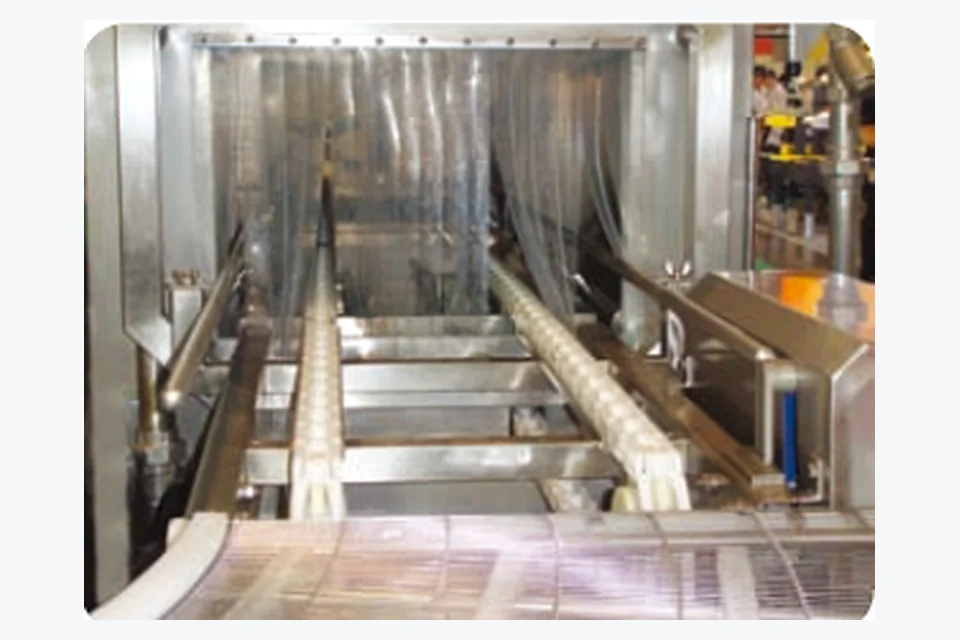
Open area describes how much of the conveying face is open, but process behaviour also depends on the shape, size and distribution of the openings. A product can bridge one 35% pattern comfortably and catch on another pattern with a similar percentage.
Open-area examples
| Tonhöhe | Open-area examples |
|---|---|
| 15,2 mm | 14% / 28% |
| 19,05 mm | 16% |
| 25 mm | 29% straight / 52% radius |
| 25,4 mm | 8%, 34%, 35% straight / 47%, 55% radius |
| 27,2 mm | 38% |
| 50,8 mm | 20% auf einer Konfiguration |
Drainage vs product support
Begin with the smallest or softest product. Ask how much surface it needs to remain stable, then choose enough opening to meet the process goal. If a belt drains very well but allows product to tilt or mark, it is not a successful process design.
Airflow and cooling
Cooling applications can benefit from through-belt airflow, but airflow depends on the entire conveyor and product bed. Open percentage is therefore an input to the thermal/process design, not a stand-alone cooling-capacity rating.
Debris release and cleaning
Open patterns can allow crumbs, water or process debris to leave the conveying surface. They can also create hinge/opening areas that need an appropriate cleaning routine. Describe the actual cleaning method and the type of debris rather than simply asking for “easy clean”.
Open area on a radius belt
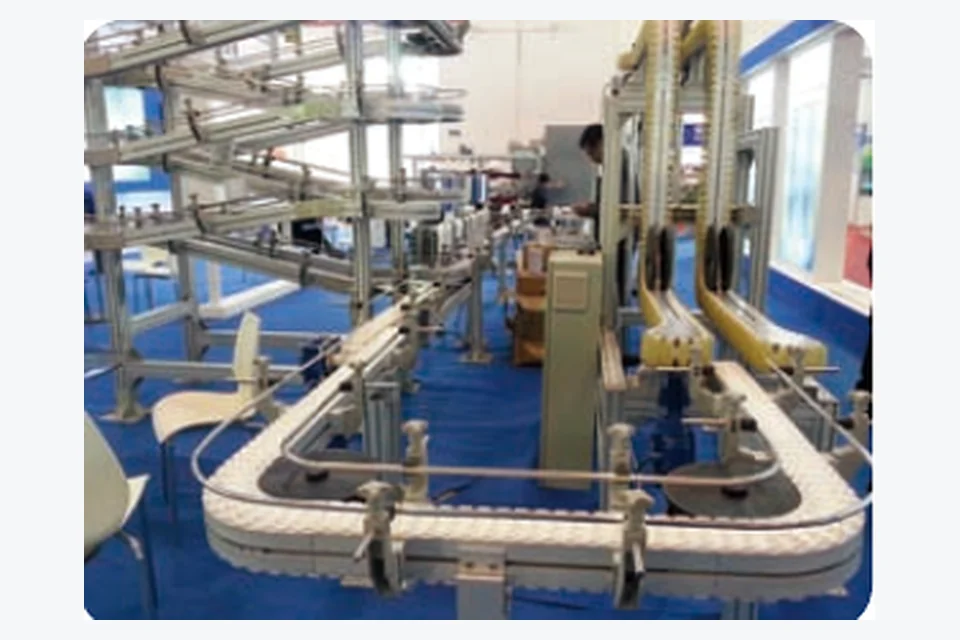
A curved conveyor adds lateral articulation and guide forces. Select the radius family first, then compare the open-area options available within that geometry. A straight 38% open belt and a radius 47% open belt are not substitutes simply because both are “open”.
RFQ questions
| Question | Why it matters |
|---|---|
| What must pass through the belt? | Water, air, crumbs or other debris define the process goal |
| What is the smallest product footprint? | Checks bridging/support |
| Straight or radius? | Selects the mechanical family |
| What is the pitch/width? | Narrows product and drive family |
| What are the transfer points? | Checks product stability at edges |
How to compare two open patterns
If two candidates both look sufficiently open, place the smallest product footprint over the actual pattern or drawing. Check where the product contacts the ribs, whether an edge or soft area can enter an opening, and whether the transfer end changes the support. Then compare the process objective: water removal, cooling airflow or debris release. The better percentage is the one that solves the process without creating a product-handling problem.
For replacement work, photograph the opening pattern with a scale. Percentage alone is rarely enough to identify the mechanical family.
Need help narrowing the configuration?
Send the information you already have. Missing fields can be identified during review rather than guessed.